Independent product · Design + engineering · 2026–present
PlanMap Chicago
Making public opportunities easier to discover, understand, and access.
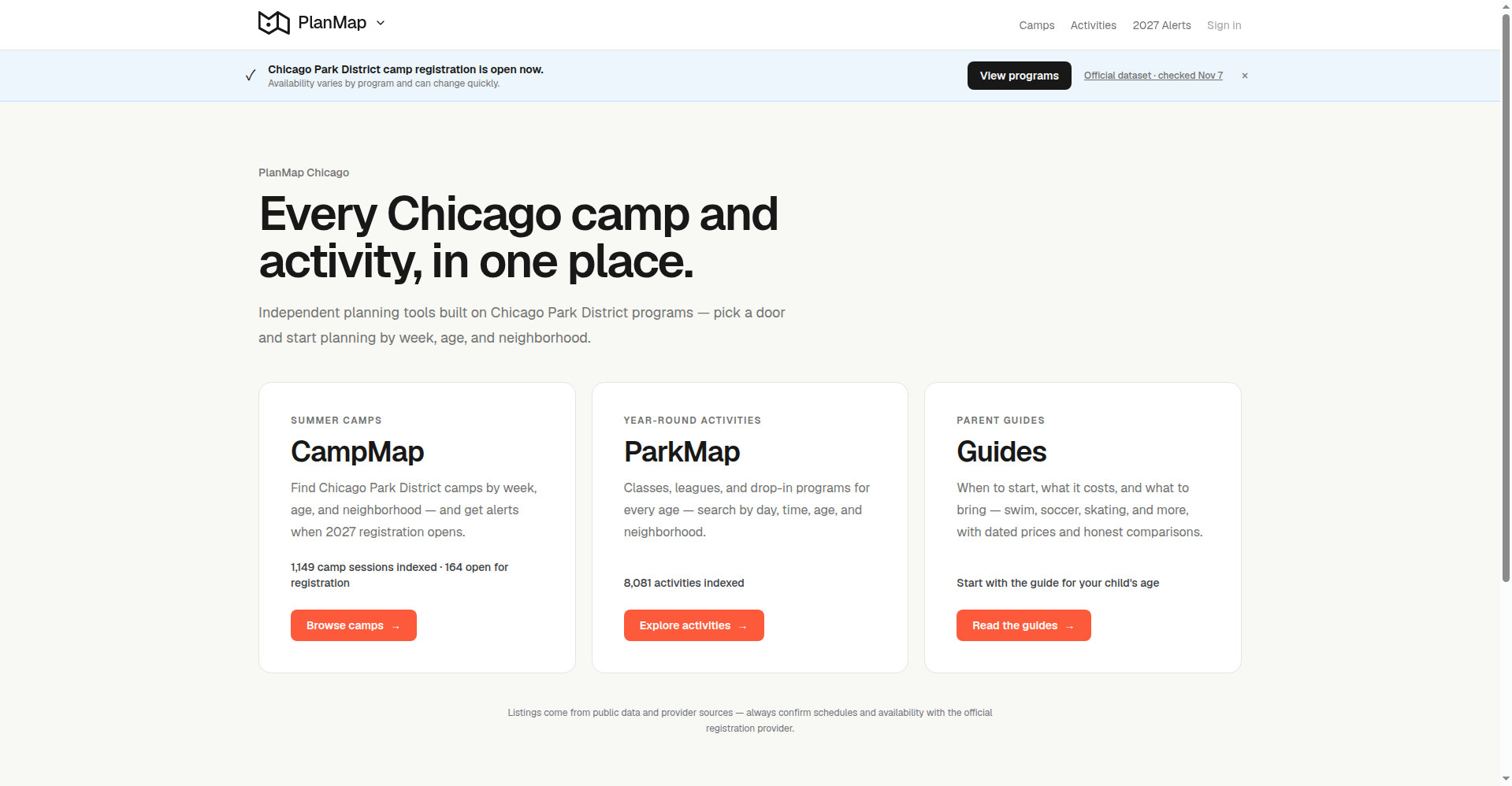
What began as curiosity about a working public platform became an independent design experiment: could better discovery help more Chicago families use the programs already available? Explore the live product at planmapchicago.com ↗.
01 / Why I built it
The system worked. I wondered if discovery could work better.
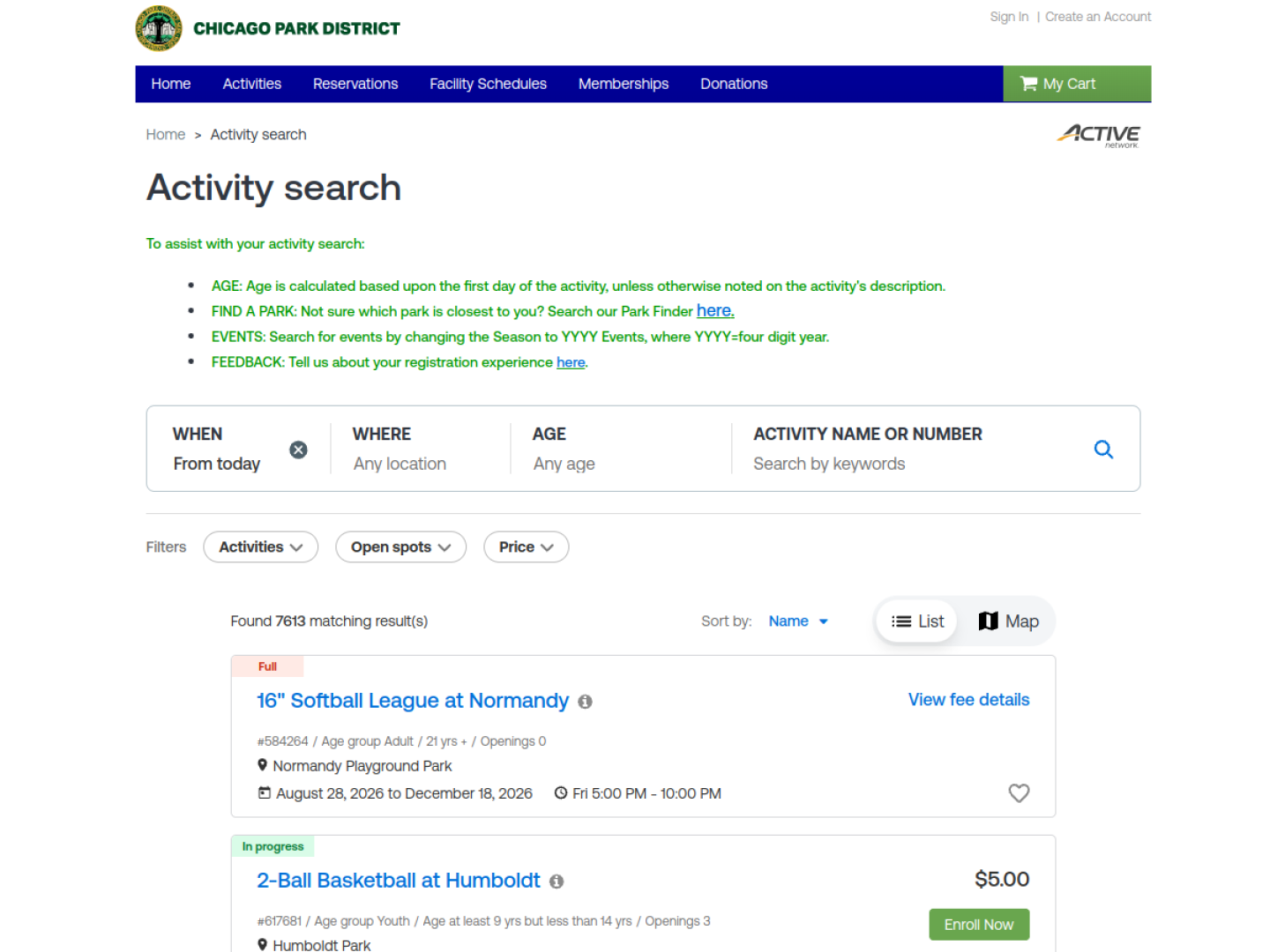
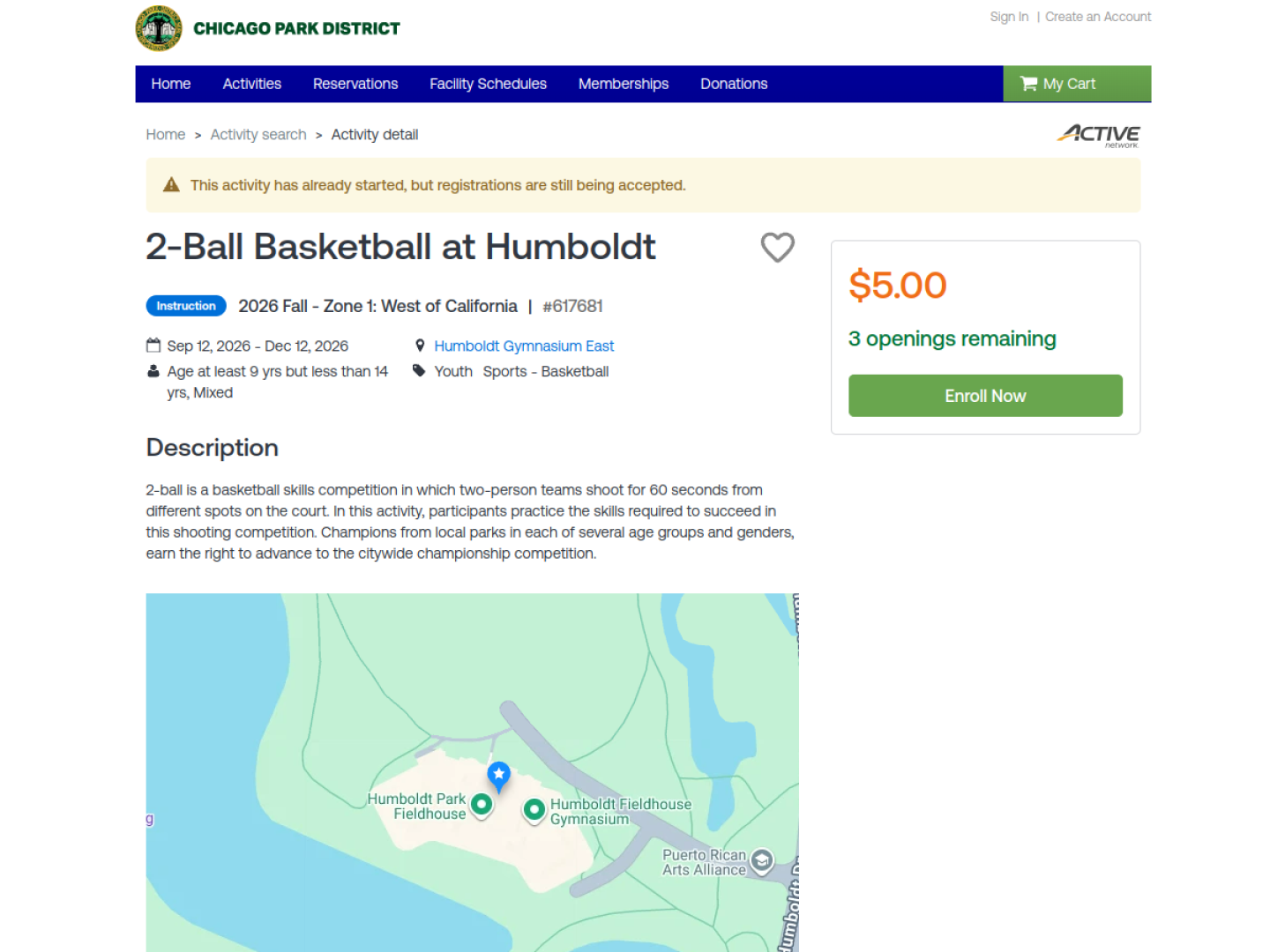
The Chicago Park District already had a functional catalog, registration, waitlists, and data access. The challenge wasn't the technology or the transactions—it was helping families discover and make sense of what was available. As a parent, I was curious whether I could bring the same care for discovery found in great consumer products to a public service, and explore what a more intuitive entry point might look like.
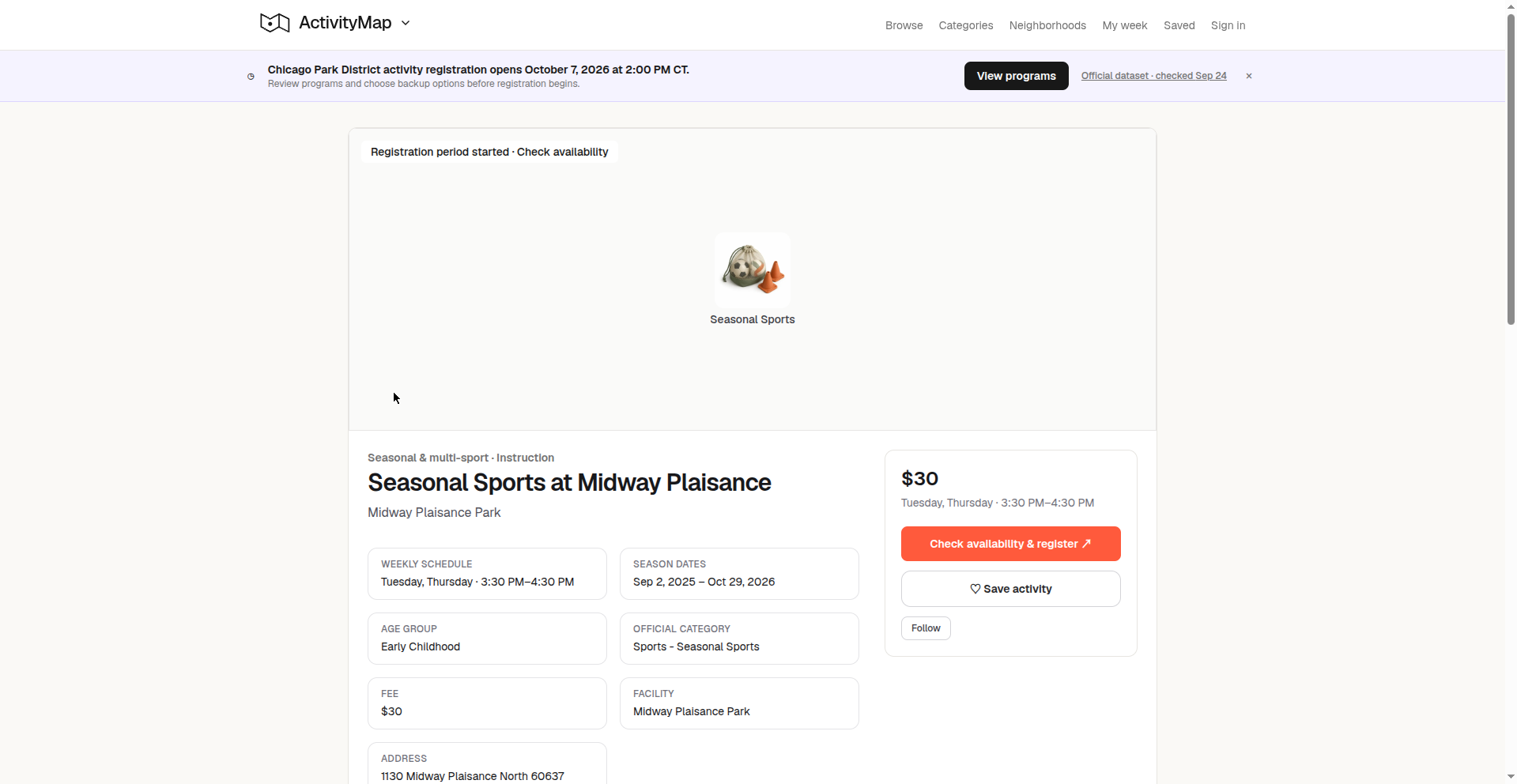
Existing Park District experience
Challenge 01 / Product discovery
One catalog. Different ways to discover.
Not everyone starts with the same question. My first step was to diagnose the UX problem: registration was already supported, but discovery was where I saw an opportunity. Starting from first principles and studying strong discovery products such as Airbnb, I mapped the different mindsets families might bring to the same underlying catalog.
Some parents know which activity they want and will travel for it. Others ask what's available around their neighborhood. Families juggling multiple children need to coordinate across schedules, not just find an individual listing.
Discovery
A family journey: from finding activities to planning the week
I explored how a parent with multiple kids could discover options for each child and bring their choices into My Week. The weekly organizer was one particularly additive journey, not the destination for every persona. A second highlight was location-first discovery: showing someone who doesn't know what to search for what is available around them.
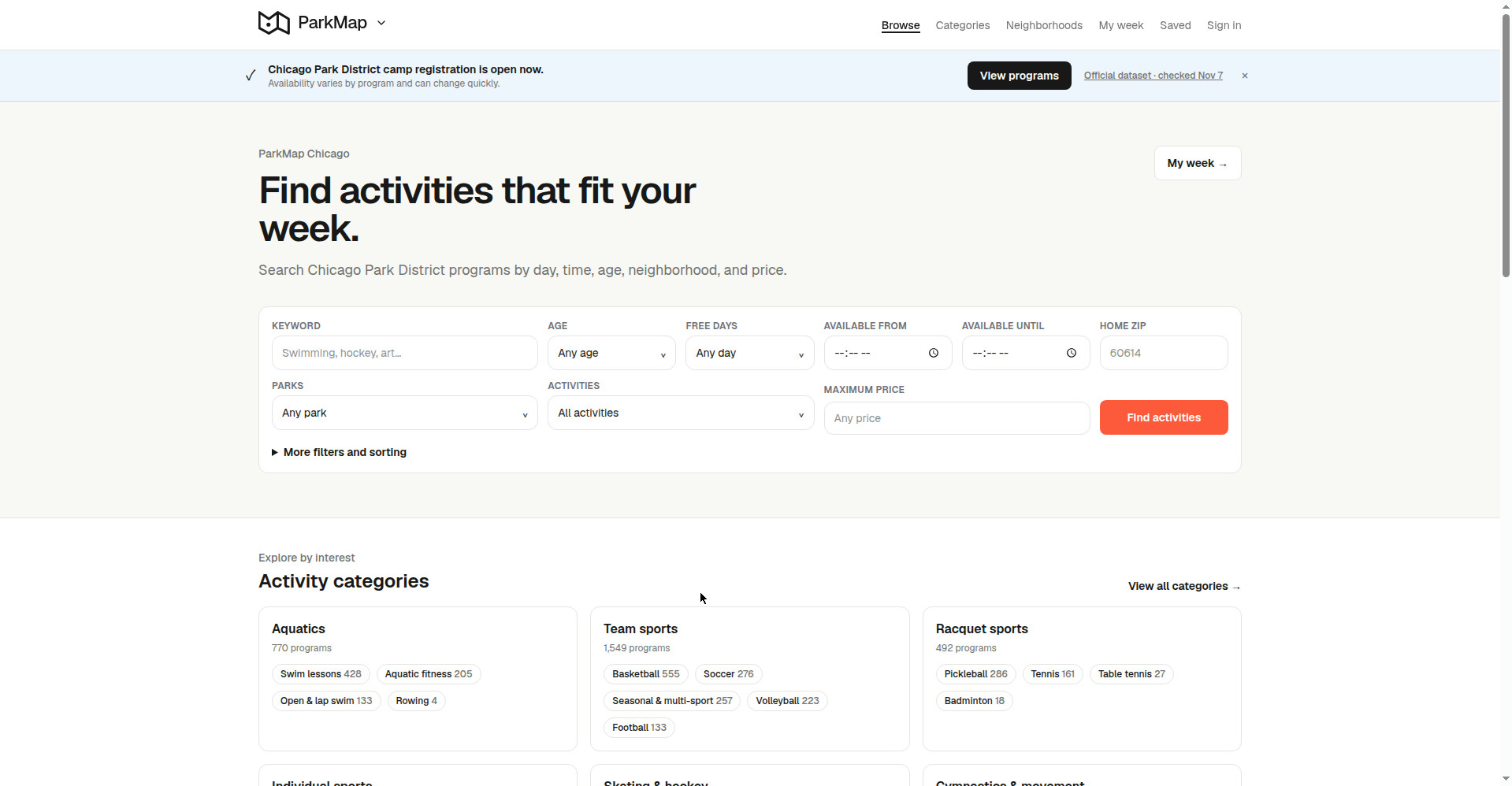
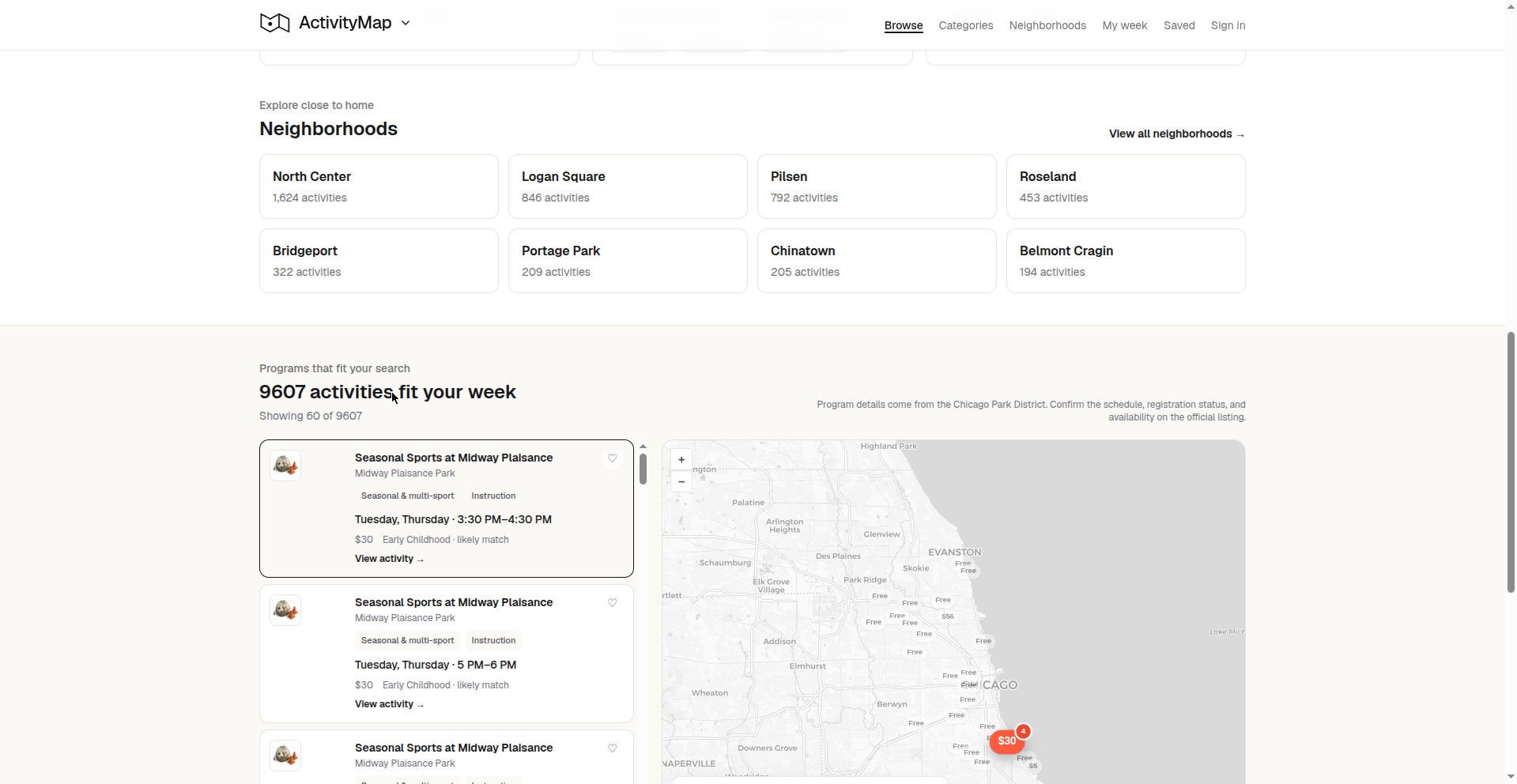
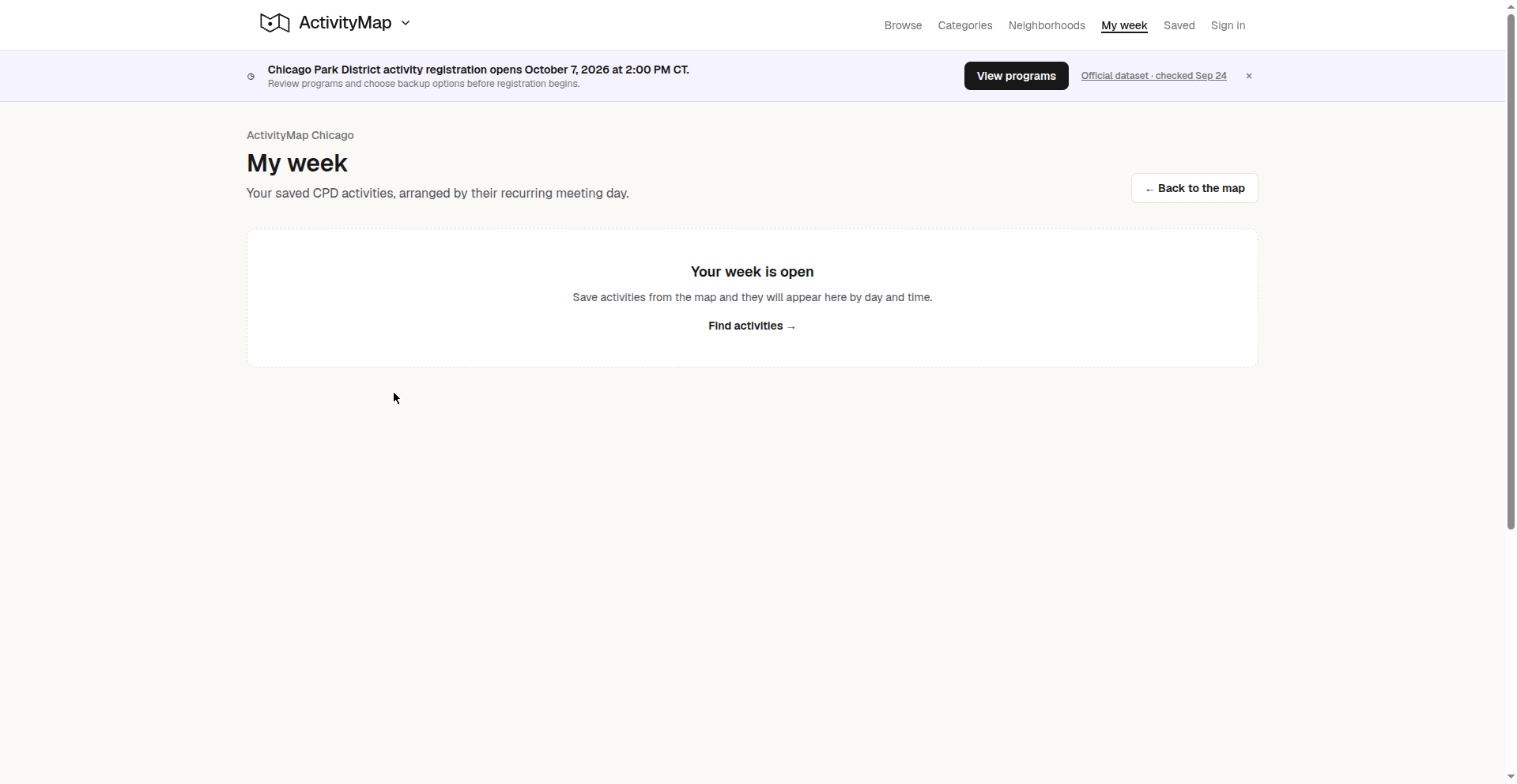
These paths illustrate the discovery directions I explored; they are not claims of validated persona segments.
Challenge 02 / Reframing the problem
Discovery was only half the problem.
Finding a good program is not the same as getting a spot. My first concepts came from product evaluation, first-principles reasoning, and strong discovery experiences. I also had informal feedback from other parents, but wanted to test my thinking beyond my immediate circle. So I built an AI-assisted social-listening agent to collect and synthesize public discussions among Chicago parents.
Those conversations revealed a second layer of friction: even after finding a promising program, families still had to prepare for opening dates, queues, waitlists, and fast sellouts. The research broadened the opportunity from better discovery to registration readiness.
AI-assisted social listening
An agent-assisted workflow gathered public parent discussions, grouped recurring concerns, and helped me pressure-test the initial design direction. The workbench below shows how that listening runs — and the signal card is one real example from the November 5 pass, quoted verbatim and linked to its public source.
"I want to do some social listening for PlanMap Chicago's user research. I want to understand what might be the market size of underserved community, versus middle class communities. I want to understand the market for camp, activity versus events. Come up with a research plan for that"
It also runs on a schedule: a daily refresh, weekly scans, a Monday brief — with registration-pain queries going daily around the winter opening."The Chicago Park District camp sign-up is a ticketing operation… refreshing pages with the same focus as someone trying to get concert tickets."
@showcasingchicago, Oct 15, 2026 · Instagram reel ↗What it changed: the research broadened the opportunity from better discovery to registration readiness.Ling decides. Drafts come back for her pick, and nothing posts, merges, or ships without her tap. The loop closes when the next sweep checks whether the complaints died.

Choosing what to build responsibly
I explored preparation tools, reminders, and automation. Faster registration tooling can also reinforce the advantage of people who already have technical resources; that is a trade-off to test, not a claim that I ran a formal fairness study. The next planned step is a free, explicitly opt-in SMS reminder flow. Following a park or saving a program is not the same as consenting to texts.
Challenge 03 / Research-led access strategy
Equity isn't a translation toggle.
A better interface can still exclude families who cannot find it—or navigate the last mile of registration. I wanted to understand access for Spanish-speaking families rather than assume translation alone would solve it. I directed an AI-assisted, bilingual research scan and public social-listening investigation, treating the findings as directional evidence and documenting their limits before turning them into priorities.
How I created the report
The investigation compared official Park District pages with school and library resources, Spanish-language guides, community organization information, public posts, and park-level evidence. It tagged provider-listed versus secondary facts and explicitly flagged unverified claims. The follow-up tested whether public parent conversations reinforced the first report—and where accessible public evidence was absent.
Three findings that changed the direction
The obstacle extends past search.
The audit found no Spanish language option in the official site's visible text and no equivalent Spanish registration how-to. The separate registration portal's full language support was not verified.
Design response: explain the actual steps in Spanish, without pretending the official portal is localized.Affordability information is part of access.
Program prices and financial-assistance routes vary. The scan did not find an equivalent Spanish-language explanation of the assistance application.
Design response: verified costs and assistance instructions, specific to the park.Distribution is part of the product.
Schools, libraries, field houses, and community groups surfaced as meaningful channels. Public comments offered limited direct testimony, and private conversations were not accessed.
Design response: printable, forwardable resources—not an SEO-only strategy.Turning research into decisions
Chicago Park District & the Spanish-speaking community
The November 5 demand-and-access scan, subsequent public social-listening pass, and Reddit gap-fill appendix preserve methods, source links, evidence labels, and unresolved questions. This isn't user-interview research or proof of an equity outcome.
OFFICIAL SOURCES · SECONDARY EVIDENCE · KNOWN GAPS
PRODUCT IMPLICATIONS
What the research couldn't tell me
Relevant private Facebook and WhatsApp groups were outside the scope. Public conversations were sparse, and not finding a complaint in an accessible channel does not mean no barrier exists. Before claiming actual access impact, I would test the materials with families and community partners, rather than treating an AI-assisted evidence scan as direct user research.
Engineering / Systems thinking
Shared data foundation. Distinct user journeys.
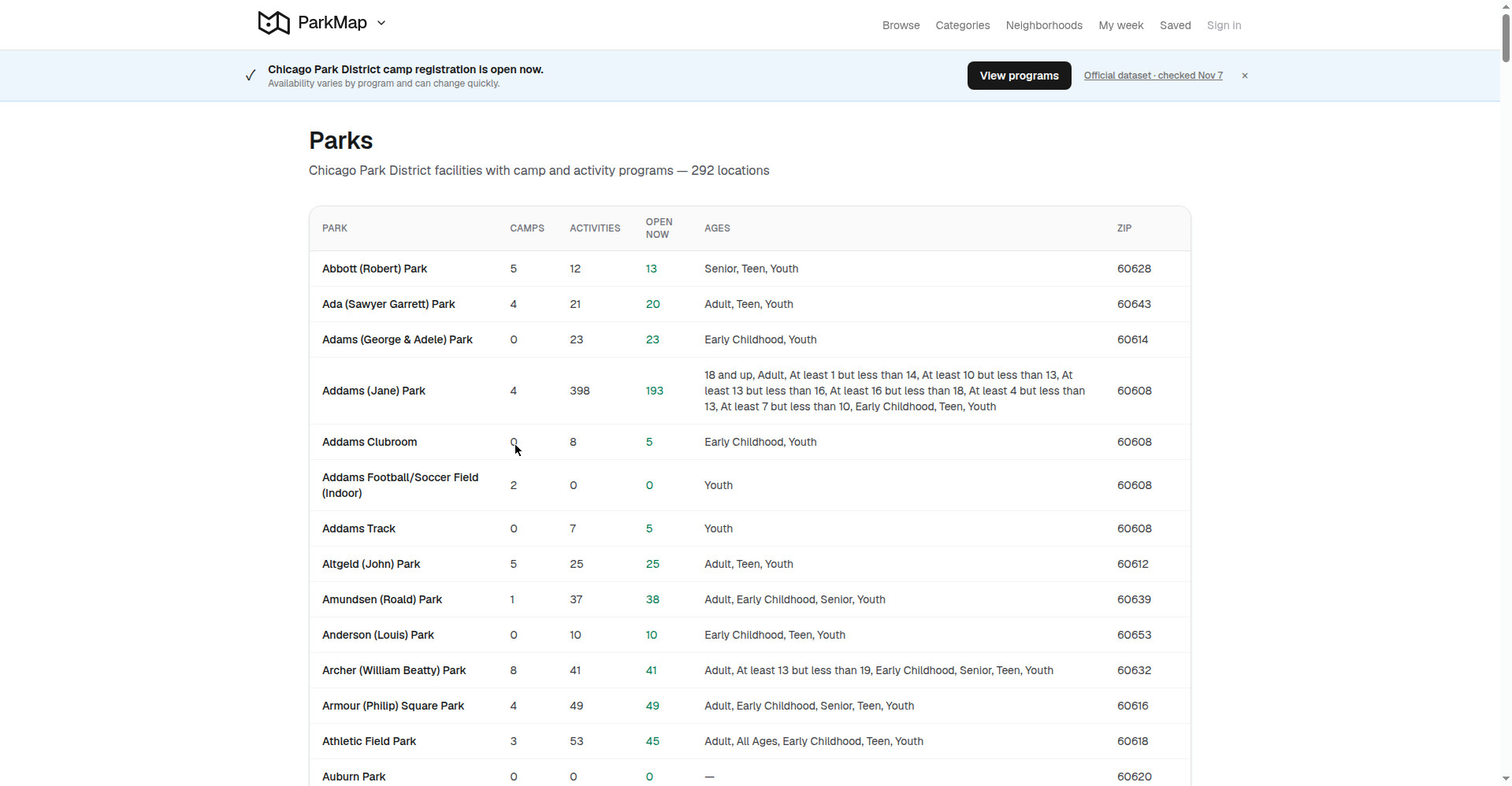
I designed the underlying structure for the products I wanted to build—not just the screens I needed first. Summer camp planning starts with dates; activity discovery often starts with recurring days and times; a future events product could start with what's happening now. Different journeys can share parks, locations, eligibility, and reliable source data without forcing distinct camp and activity categories into the same model.
Data trust is a UX decision
PlanMap is API- and database-backed. The repository uses a common Postgres store, source ingestion, and separate queries for camps and recurring programs. It distinguishes durable provider information from transient seasonal sessions and carries provenance and freshness information. That matters because expired listings or uncertain registration details can actively mislead a family.
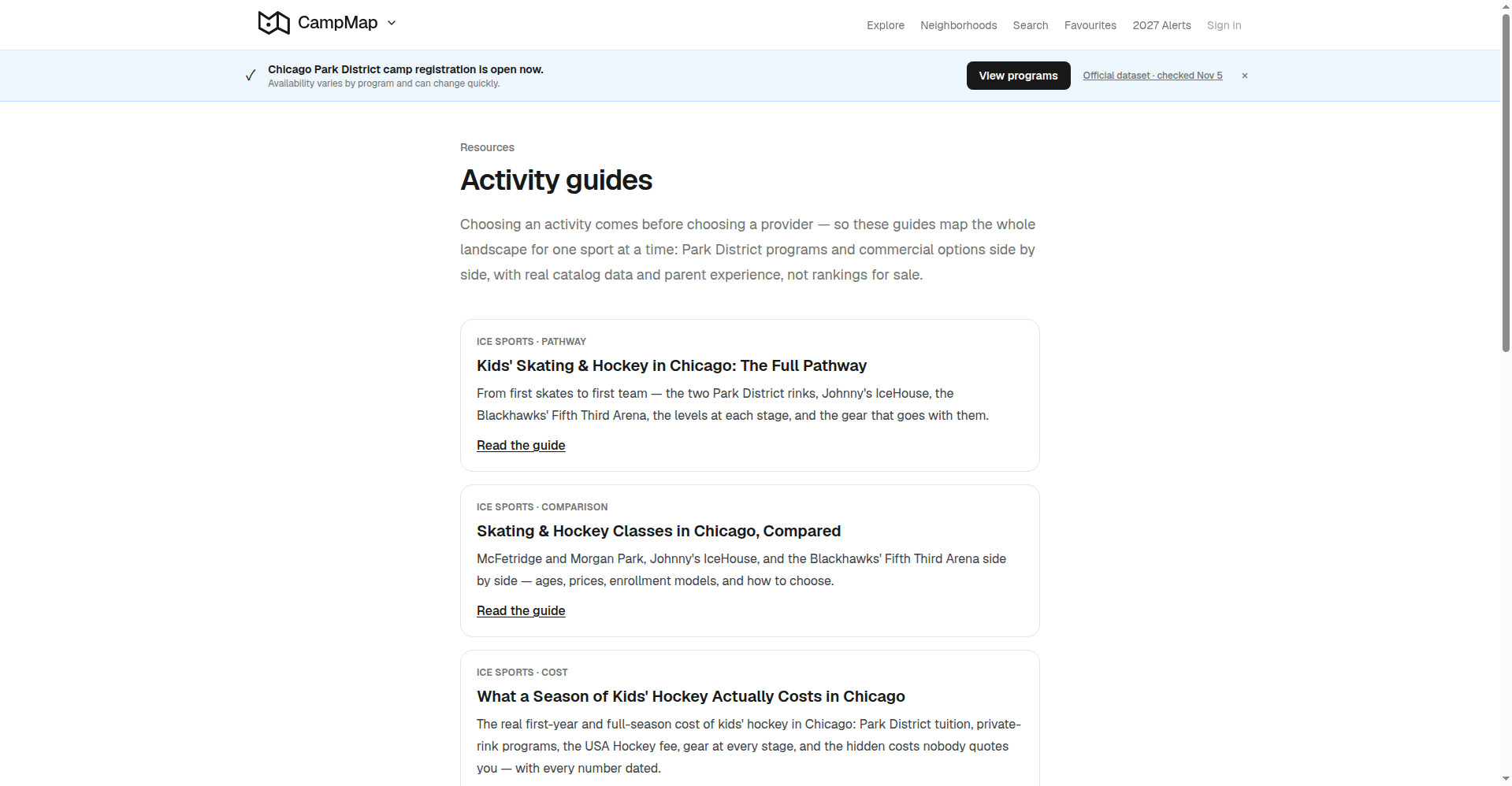
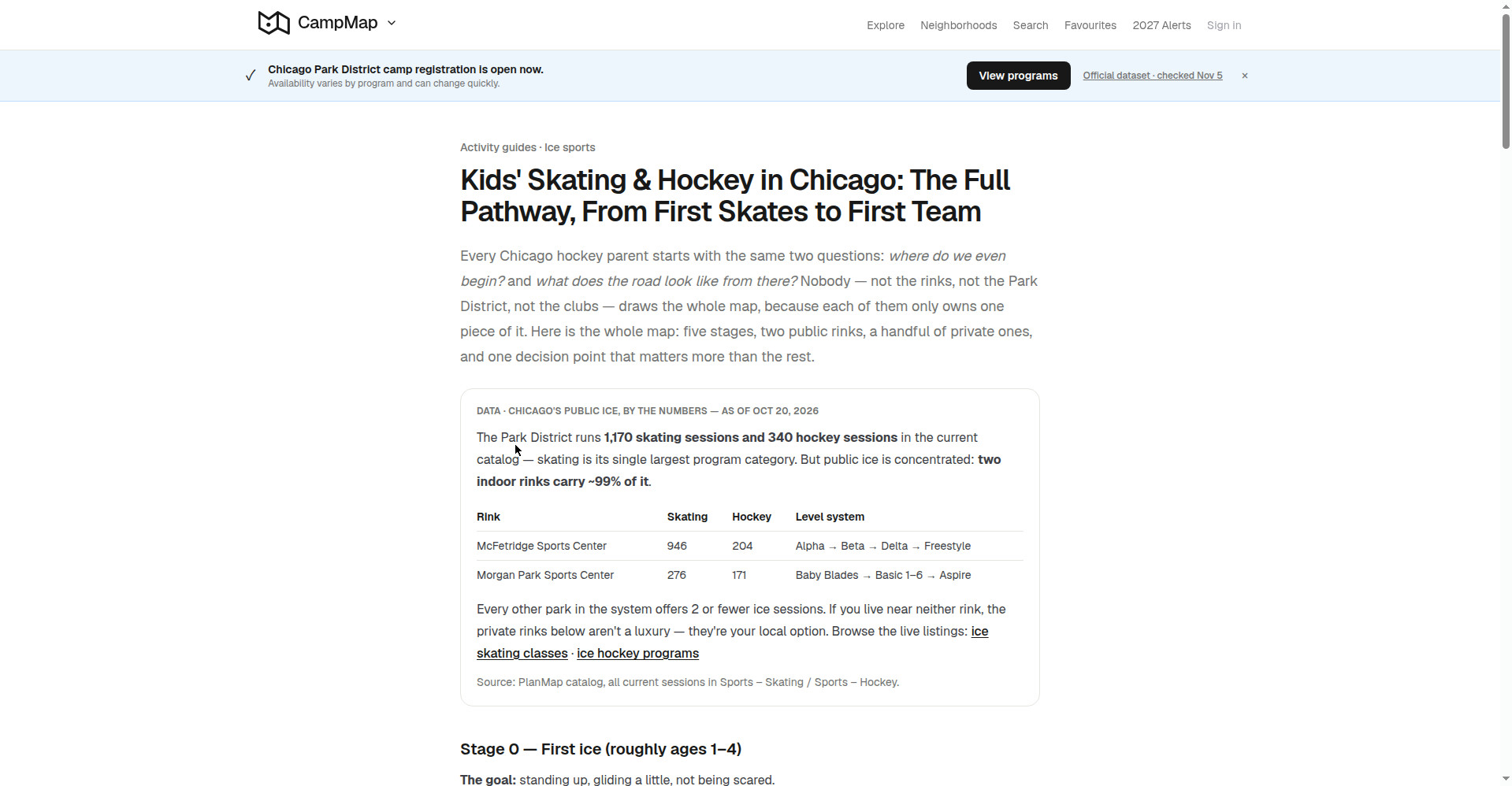
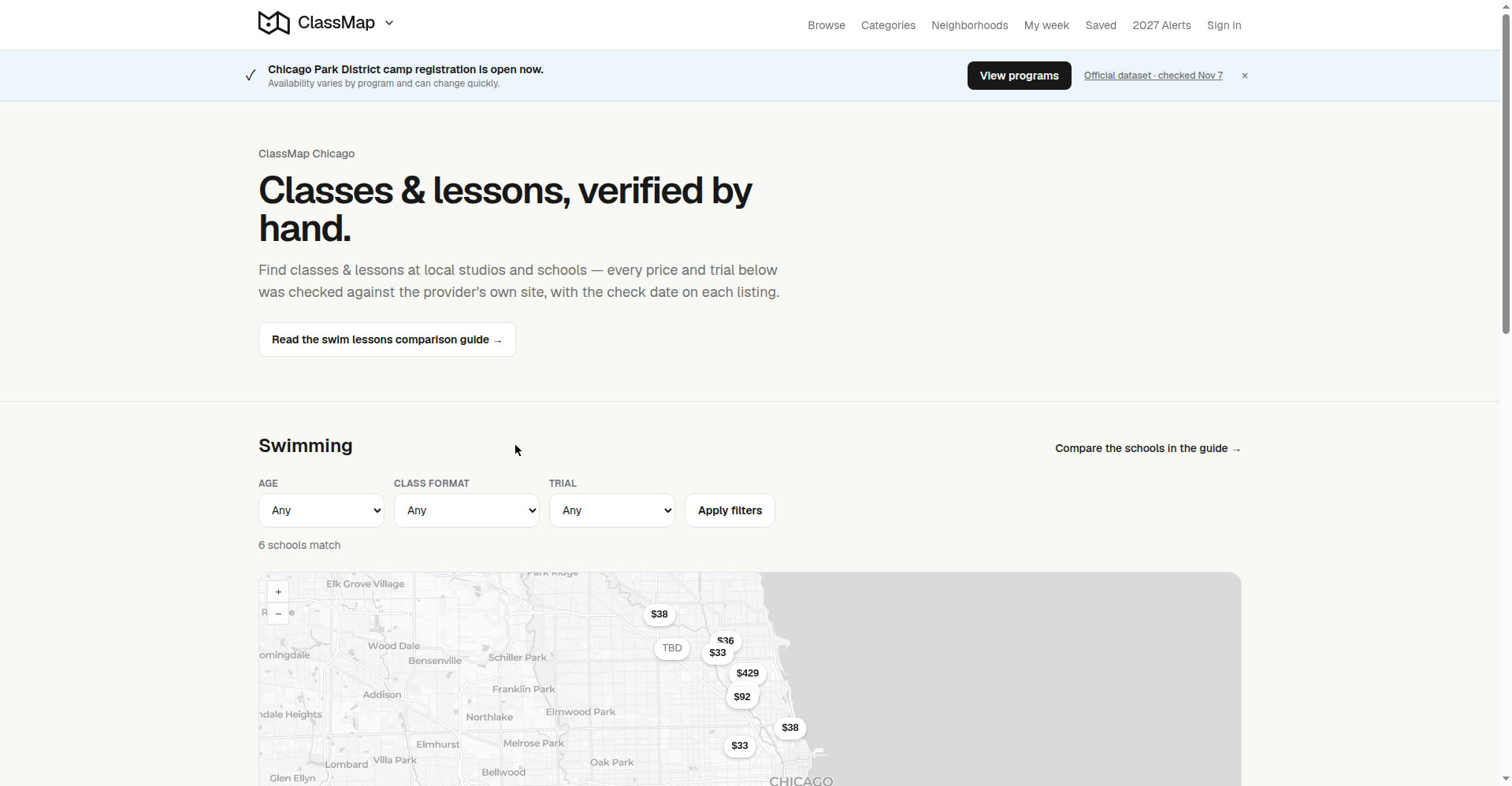
The shared foundation has made it possible to add guides and ClassMap commercial-provider listings without rebuilding the product from scratch. I use PRDs and incremental pull requests to evolve features, verification rules, and content operations.
Guides and ClassMap, on the same foundation
The outcome / Product evolution
Built layer by layer.
PlanMap grew from a camp finder into a broader family planning platform. Each iteration added a new way to discover, evaluate, prepare for, or access local programs. This roadmap is grounded in merged product PRs; unfinished work stays visibly separate.
Next: from discovery to access
SMS reminders will help families prepare for registration windows once messaging is approved. Community outreach is the next distribution experiment: get multilingual planning resources to families through trusted local channels, not just search.
These are next steps, not measured outcomes. I have not claimed increased registration success or equitable access without evidence.
Explore PlanMap Chicago ↗