Behind the sidekick
How I built my AI sidekick
This guide is a small product experiment: can AI make a designer's work easier to explore without inventing credentials, revealing private information, or replacing the actual case studies?
01 / Why it exists
Help people find the interesting part
Instead of repeating a résumé, the sidekick can answer questions, find a project related to someone's curiosity, or lead them to the exact part of a case study where a design decision happened. It's a small experiment in making a portfolio easier to explore.
02 / Under the hood
Six layers, built around one modest job
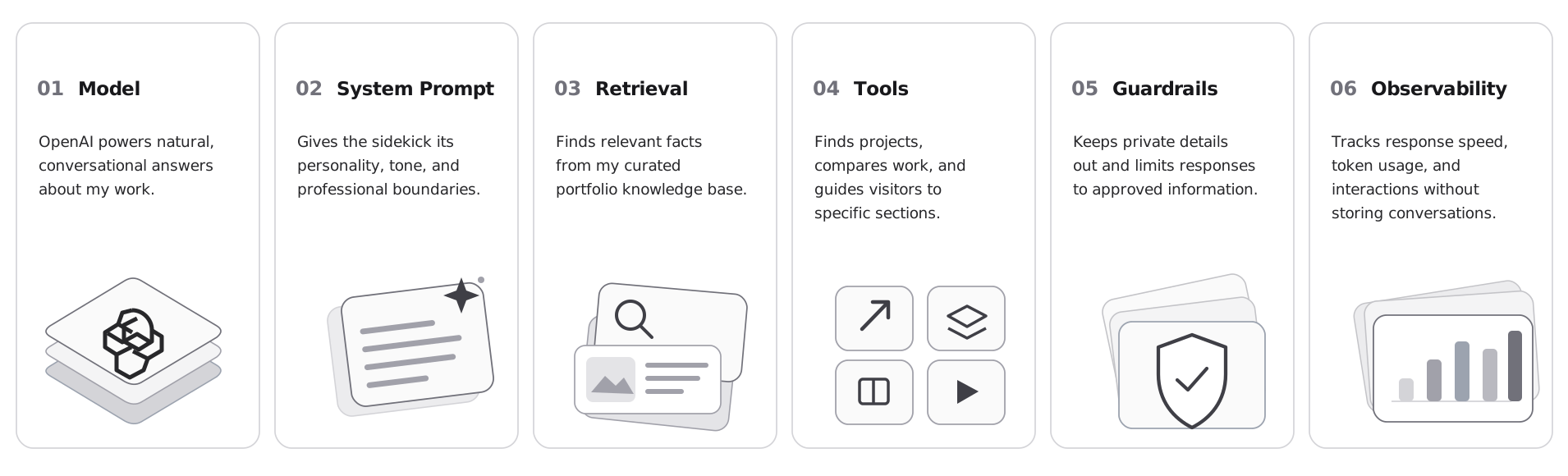
- Model. A single OpenAI model handles generated answers, with bounded output size. Verified career facts don't need an AI call.
- Prompt. A separate instruction set keeps the tone conversational and the scope tied to Ling's work—not generic recruiting copy.
- Retrieval. Public case-study sections are automatically indexed from the portfolio's own project data at deployment; career facts remain curated. Keyword matching and an AI topic router select relevant sections. No vector database, scraping, or separate content update is required.
- Tools. A typed, read-only set of portfolio actions can surface project links, jump to a research section, suggest a short tour, compare projects, open an approved live demo, or show contact options. The visitor chooses whether to open anything.
- Guardrails. Basic scope and privacy checks run before the model; the assistant cannot access protected case-study contents, arbitrary websites, private files, or visitor accounts.
- Observability. The server records anonymous categories, response latency, source coverage, token usage when available, and action clicks. Visitor questions are not recorded in those custom events.
03 / Trust and trade-offs
Useful without pretending to know everything
Neither a system prompt nor a keyword filter can guarantee a perfect answer. The most important boundary is keeping private information out of the knowledge base entirely. Action links come from an approved list, and confidential case studies still require access outside the chatbot.
For a small portfolio, deriving a bounded index from the published case studies is easier to audit than crawling everything on the internet. The index updates when the site redeploys, and protected projects contribute only their public summaries. It is also intentionally simpler than a full agent with external write permissions.
04 / Engineering
Small enough to understand and improve
The experience is built with Astro, TypeScript, serverless endpoints, and Vercel AI SDK. The model streams plain text; interactive actions are rendered by the application from validated data. Navigation stays under the visitor's control.
Automated tests check routing, retrieval, access boundaries, approved links, and basic behavior. Structured logs help spot errors and slow responses without storing the raw question. Model accuracy still needs ongoing human evaluation, and distributed rate limiting and spending controls remain important production hardening tasks.
05 / Keep exploring